Why Am I Getting Fake Leads From My Website?
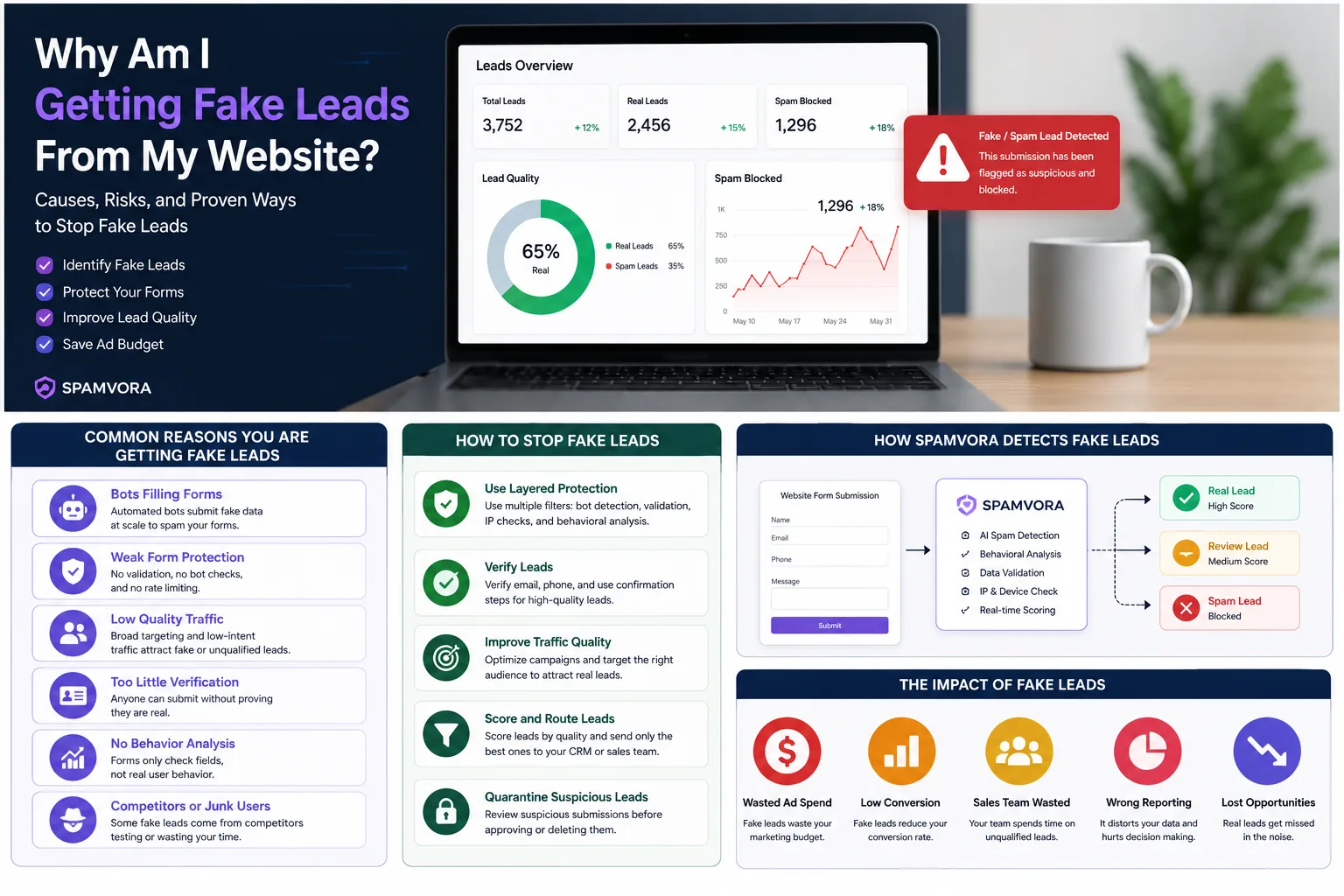
If your contact form is full of junk submissions, random emails, fake phone numbers, or people who never respond, you are not alone. Fake leads usually come from bots, low-quality traffic, deceptive submissions, or forms that are too easy to abuse. In many cases, the issue is not your offer — it is the path from click to form submission. Fake leads can waste ad spend, distort reporting, and make your sales team chase people who were never serious in the first place.
The most common reasons you are getting fake leads
1) Bots are filling out your forms automatically
A huge share of fake leads come from automated scripts or bots that submit forms at scale. These submissions often look real at first glance, but the email, phone number, or message is useless. Some tools even use stolen or random details to make the lead look legitimate.
2) Your forms are too easy to abuse
If your form has no strong validation, no honeypot, no rate limiting, and no behavioral checks, it becomes easy for spam to pass through. Simple forms are great for conversion, but if they are too open, they also make abuse easier.
3) Your traffic quality is low
Fake leads often show up when traffic is coming from broad, low-intent, or badly optimized campaigns. That can happen with paid ads, referral spam, or traffic sources that attract volume rather than real buyers. When the traffic is weak, the leads usually are too.
4) The form asks for too little verification
If anyone can submit a name, email, and phone number without any proof they are real, fake leads get through easily. Verification steps matter because they raise the cost of abuse. Without them, your inbox becomes an open door.
5) Your site is not checking behavior, only fields
Spam is often detectable before the form is even submitted. Timing, mouse movement, IP reputation, repeated patterns, and device behavior can all reveal suspicious activity. If you only inspect the text fields and ignore behavior, you miss a lot of bad submissions.
6) Competitors or junk users may be testing you
Some fake submissions are not random bots. They are competitors, agencies, or users trying to probe your business, waste your time, or get around your sales process. That is especially common on lead-gen sites and service businesses where each form submission has value.
How to stop fake leads from your website
Step 1: Add layered protection, not just one filter
The best setup is not a single “spam blocker.” It is layered protection: field validation, bot checks, behavioral scoring, IP checks, allowlists/blocklists, and quarantine for suspicious submissions. That is the kind of approach Spamvora is already moving toward with AI lead scoring, spam detection, and real-time smart detection.
Step 2: Verify leads before they hit your sales team
Use email verification, phone verification, and if needed, a second-step confirmation for high-value leads. That reduces noise and keeps your team focused on people who are actually reachable. The more valuable the lead, the more important this step becomes.
Step 3: Tighten the traffic source
Look at where the fake leads are coming from. If they cluster around one campaign, audience, country, placement, or referral source, you have found a leverage point. Better targeting usually beats more filtering because it prevents the bad lead from appearing in the first place.
Step 4: Score and route leads by quality
Not every submission deserves the same treatment. A good system should separate hot leads from cold leads and spam, then route only the right ones to the sales inbox or CRM. That is especially useful for agencies and businesses running paid ads, because speed and prioritization matter. Spamvora’s current homepage already points in this direction with lead protection, form-plugin support, and budget-saving language.
Step 5: Keep a quarantine for suspicious submissions
Do not permanently delete questionable leads right away. Keep them in quarantine so real leads are not lost by mistake. This lets you review patterns, recover valid submissions, and improve your filters over time.
Why this matters for your business
Fake leads do more than waste time. They distort conversion data, make campaigns look worse than they are, and can push your sales team to follow up on noise instead of real opportunities. If your reporting is full of junk, your decisions get worse too.
That is why the best fix is not only “blocking spam.” The better goal is to build a system that tells you which leads are real, which leads need review, and which leads should never reach your team in the first place. That matches Spamvora’s current positioning as an AI spam protection and fake lead prevention product.
What to do next
If you want fewer fake leads, start with the highest-impact changes first: improve the form protection, verify leads, clean up traffic sources, and score submissions before they reach your inbox. Then turn the result into a repeatable system for your website, your CRM, and your ad campaigns. That approach is much more aligned with what Google and Bing reward: useful, clear, crawlable content that satisfies real user intent.
FAQ
Why am I suddenly getting fake leads from my website?
Usually because bots, spam traffic, or weak verification found a gap in your form or campaign targeting.
Are fake leads always bots?
No. Some are automated, but others come from deceptive users, poor traffic quality, or competitors testing the form.
How do I reduce fake leads fast?
Add layered spam protection, verify contact details, tighten ad targeting, and quarantine suspicious submissions before they reach sales.
Does Spamvora fit this article?
Yes. Spamvora’s current homepage positions it around AI spam protection, fake lead prevention, real-time smart detection, WordPress form integrations, and credits-based plans, so this topic matches the product well.

Jerry Miller
Jerry Miller is a technology writer specializing in AI lead intelligence, spam prevention, website security, and conversion optimization. He focuses on helping businesses understand how fake leads, bots, and low-quality traffic impact marketing performance and revenue. His articles cover practical strategies for improving lead quality, protecting web forms, and using AI-driven systems to identify real customer opportunities.